In many residential projects, power and lighting are still treated as two separate conversations.
Lighting is discussed in terms of layout and fixtures. Power is handled later, often focused on outlets, circuits, and basic requirements.
Because in a well-integrated home, power and lighting are not separate systems. They are part of the same framework. And when they are planned together from the beginning, the result is cleaner, more flexible, and far easier to live with.
Where Separation Creates Friction
When power planning and lighting design are handled independently, coordination becomes reactive.
Lighting layouts may look correct, but the circuiting does not support how those lights should behave. Controls get added late, often resulting in too many switches or inconsistent user experience. Outlets and access points are placed for convenience, not for how the space is used.
These are not major failures. They are small misalignments that add up.
You start to see it in everyday use. Lights that cannot be grouped the way they should be. Controls that feel disconnected from space. Systems that work, but not together.
In high-end homes, these gaps become more noticeable.
Thinking in Systems, Not Components
Designing power and lighting together requires a shift in approach.
Instead of thinking in terms of individual devices, you start thinking in systems.
Lighting is not just a fixture. It is a controlled layer within the home. Power is not just supply. It is what enables flexibility, control, and integration.
This is where electrical planning becomes part of the design process.
Circuiting is based on how spaces are used, not just how they are wired. Load distribution considers both performance and future expansion. Control strategies are defined early, so the number of switches and interfaces can be reduced.
What Integration Actually Changes
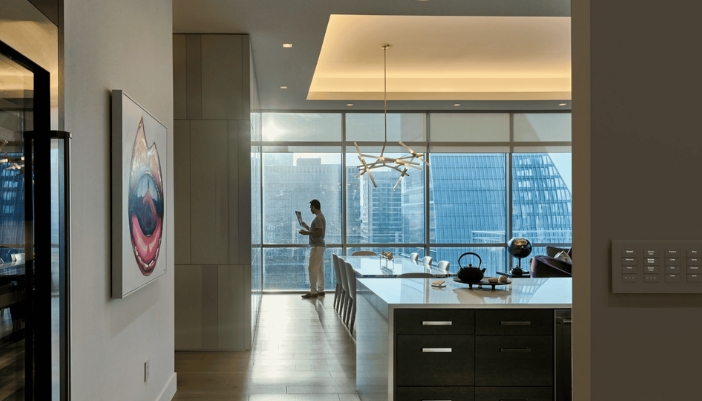
Source: Lutron
When power and lighting are designed together, the improvements are immediate, even if they are not always visible.
- Lighting zones can be controlled as a group, not as individual fixtures
- Dimming performs consistently because loads are planned correctly
- Switch locations are reduced and placed with purpose
- Power is available where it is needed, without overloading walls with outlets
- Systems are ready for integration with shading, audio, and automation
It also avoids the need for workarounds later, which are often where complexity is introduced.
Clean Design Starts with Clean Planning
One of the most common goals in high-end residential design is simplicity.
Fewer elements on the wall. Cleaner ceiling lines. Less visible technology. Achieving that requires more coordination, not less.
Reducing a bank of switches into a single control point depends on how circuits are grouped. Hiding lighting sources depends on how power is routed. Integrating systems depends on how everything is structured from the start.
These are electrical decisions, but they directly impact the design outcome.
Planning for How the Home Will Evolve
Another advantage of integrated electrical planning is flexibility. Homes change over time. Spaces are used differently. Technology evolves.
When power and lighting are designed together, it becomes easier to adapt without reworking the entire system.
Additional controls can be added. Lighting scenes can be adjusted. Systems can expand without major disruption.
This is especially important in projects where long-term usability matters as much as the initial result.
A Practical Approach on Site

From a project standpoint, designing power and lighting together also improves execution.
Coordination between trades becomes clearer. Drawings are more aligned. Installation is more predictable.
Instead of solving conflicts during construction, most decisions are resolved during planning. This reduces delays, avoids rework, and maintains the integrity of the design.
For homeowners and designers, it also means fewer surprises.
A More Complete Way to Build
In well-executed homes, lighting responds consistently, controls feel natural, spaces adapt without effort. That level of performance comes from treating power and lighting as one system, not two separate layers.
At LIGHTWORKS, this is how we approach every project. Electrical planning, lighting design, and system integration are developed together from the beginning, in coordination with the broader design team. If you are planning a new home or renovation, this approach makes a measurable difference early on.